
Cook County Has No Rolling 72 Hour Release Archive
No official Cook County names list or booking-number archive covering the prior three days was found. The Sheriff's Detainee Discharge Tracker is a live, date-stamped workflow board. It gives no statement that completed rows remain for 72 hours, and a booking number does not reveal how old a release is.
Using today's board as if it were a weekend archive creates false gaps. A Friday discharge may no longer appear on Monday, while a Monday row may still be under review. The honest three-day method joins records from each responsible office rather than recycling the current jail roster.
How to Reconstruct Cook County's Last 72 Hours
Begin with identity and custody system, then build a positive chain for the date in question:
- If the event is current, obtain the CCDOC booking number from the Individual in Custody Locator.
- Check that exact number on the discharge board. Save the status, date, and observation time.
- Search the Cook County court case for a release, dismissal, time-served, probation, bond, or commitment order.
- Ask Sheriff Records for the actual discharge time, disposition, and receiving destination.
- Check IDOC, BOP, or ICE when the record points to another custodian.
For one named person whose booking number is unknown, use the custody-system path on the Cook County released inmates home page first.
What Cook County Records Show Across 72 Hours
There is no single three-day table. Each official source answers a different part.
| Source | What it establishes |
|---|---|
| Tracker Booking Number | Links a known CCDOC booking to today's workflow. |
| Progress and Discharge Status | Shows whether current operational work is pending or complete. |
| Court record | Shows the legal event, subject to online-summary lag. |
| Sheriff discharge record | Can document actual time, disposition, and transfer destination. |
| IDOC profile or archive | Shows continued state custody, parole, or later discharge. |
| BOP or ICE locator | Addresses federal or immigration custody. |
The tracker contains no name, birth date, charge, release reason, destination, exact exit time, or photo.
The official discharge board displays its limited current-day fields.
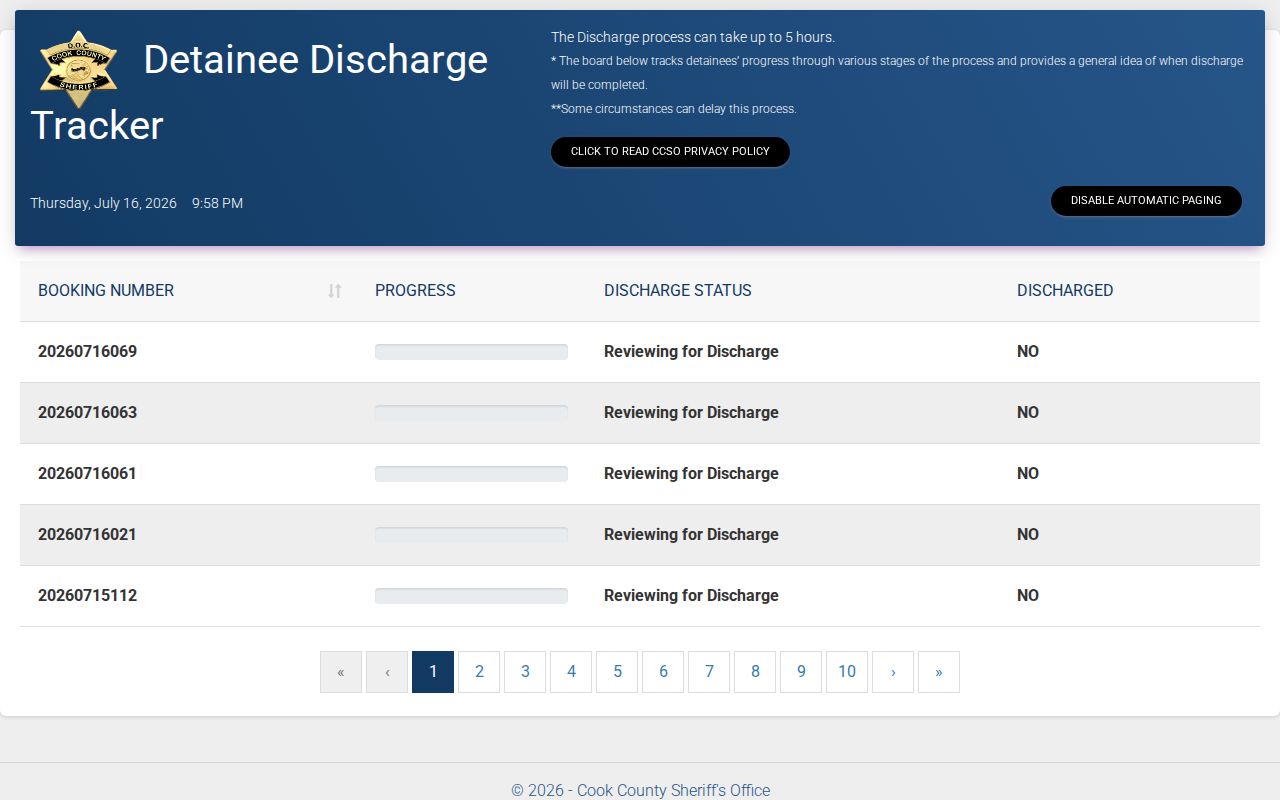
Its status layout is useful today, but it cannot stand in for three days of durable records.
Weekend Cook County Releases Have Two Timelines
Separate legal authorization from physical discharge. A court order may precede jail completion, and the Clerk says its online case summary can lag by days. The tracker may show physical processing before the legal explanation appears online.
For a Friday-through-Monday question, preserve an affirmative tracker status if visible, then obtain the official court disposition and Sheriff discharge time. GPS placement, screening, or another operational step can put valid milestones on different dates. Do not round a current observation backward into an assumed release date.
Requesting Cook County Release Records for Three Days
Corrections Customer Service at 773-674-1945 handles discharge questions daily from 8 a.m. to 8 p.m.; Records is listed at 773-674-6321. For lasting proof, give the Sheriff FOIA office the full name, birth date, booking number, and approximate dates. Request actual discharge date and time, disposition, legal authority, and receiving agency if transferred.
Illinois FOIA generally calls for an ordinary noncommercial response within five business days, with a permitted written extension in specified cases. Ask for electronic copies and segregable nonexempt portions. The response schedule is not the release date.
Illinois VINE may supply an alert but is not a permanent history. IDOC must be checked for a state commitment. For today's event, the Cook County 24 hour release page covers live monitoring.
Why Cook County's Board Cannot Become a 72 Hour List
The board uses booking numbers instead of names or photos. It rotates pages about every ten seconds with auto paging and reloads after the last page. With auto paging disabled, the browser refresh is roughly five minutes. Those behaviors describe the display, not completed-row retention.
No official three-day archive, released-name app, tracker photo, or retention statement was found. Preserve the booking number while available, then use court and Sheriff records. A no-result screen can reflect release, transfer, lag, or mismatched identity.
Leaving CCDOC also does not always mean community release. IDOC incarceration or an Adult Transition Center remains state custody. BOP and ICE outcomes require their federal tools. The durable Sheriff record should identify the receiver when the county event was a transfer.
Matching Cook County Court and Release Records
The Circuit Court file and Sheriff record should be read together. A docketed release order supplies legal authority, while the discharge record supplies the operational time and outcome. The Clerk describes its online case information as a brief, unofficial summary that can lag, so an apparently missing order during the three-day window is not proof that no order exists.
Use a case number when available and compare the person's name, birth date, booking number, dates, and charge or mittimus details. If the online docket remains unclear, obtain an official or certified disposition from the Clerk. Ask Sheriff Records to identify the receiver when the person left CCDOC through transport.
A court sentence to IDOC should lead to the state offender search. A federal case should lead to the BOP locator and federal docket. A county discharge followed by immigration custody should lead to ICE's locator and Detention Reporting and Information Line. Keeping those branches separate prevents a Cook County departure from being mislabeled as a return home.
For an arrest that never reached CCDOC, request the custody and release record from the arresting municipality or Chicago Police Department. One custodian's no-record response does not settle whether another agency held the person.
Trace Cook Releases Across Systems
A three-day search must follow the destination named by the Sheriff or court. A mittimus committing someone to IDOC means the county-jail stay ended through transfer. Search IDOC by the preserved IDOC number, last name, or birth date, then match the Cook County sentence and case. An incarcerated status confirms state custody continues. A later PAROLE status with a Parole Date shows physical state release into supervision. Projected Discharge is a later sentence milestone, not the day the person left prison.
Federal and immigration handoffs need different tools. Use the BOP Inmate Locator for a person moved into federal custody. A BOP result marked Released or Not in BOP Custody only establishes the end of BOP custody, and BOP warns that another authority may still hold the person. When ICE receives a person, use the Online Detainee Locator System or call the Detention Reporting and Information Line at 1-888-351-4024. The Cook tracker, IDOC, and BOP cannot establish an ICE release, transfer, or removal outcome.
For an older county event, submit a focused Sheriff FOIA request. Include the full legal name, date of birth, booking number, booking or admission date, and approximate discharge range. Ask for the actual discharge date and time, disposition or reason, legal authority, and receiving agency or destination. Request electronic records and segregable nonexempt portions. Then compare the response with an official Clerk docket or certified order. That chain supplies the durable answer a missing rolling 72-hour archive cannot provide.