
Outcomes After Broadview
The facility at 1930 Beach Street, Broadview, Illinois is owned and operated by U.S. Immigration and Customs Enforcement. It is federal immigration custody, not a Cook County correctional facility and not a municipal police lockup. Geography does not determine the records custodian. Cook County and Broadview officials cannot establish what ICE did merely because the site is inside Cook County.
Three outcomes must remain separate. A person can be transferred from Broadview to another ICE processing or detention location and remain in federal custody. ICE can carry out a removal, an immigration-law outcome that is not the same as release into the local community. ICE may also authorize a release, potentially subject to reporting, monitoring, bond, recognizance, or other immigration conditions. A departure from the Broadview building, standing alone, identifies none of those outcomes.
The same distinction applies when the Cook County Sheriff record says someone was “released to ICE.” CCDOC may have completed the county discharge, and its booking-number tracker may reach “Discharged,” while ICE immediately assumes custody. From the practical standpoint of locating the person, that is a transfer between sovereign systems. The county result proves only the end of county custody. The receiving ICE record must answer whether immigration custody continued.
Check Broadview ICE Status
Use the federal Online Detainee Locator System, commonly called ODLS, for a person believed to be in ICE custody. Search with accurate identifiers. The official locator may require an A-Number and country of birth or biographical information such as name, date of birth, and country of birth. Confirm the match before drawing any conclusion; spelling variants, compound surnames, and transliteration can affect a result.
- Collect the person’s correct name, date of birth, country of birth, and A-Number when lawfully available.
- Search ODLS and record only the minimum details needed to identify the supplying agency, location, or status.
- If the online result is missing or ambiguous, call ICE’s Detention Reporting and Information Line at 1-888-351-4024.
- For the Chicago-area custody question, use Chicago.Outreach@ice.dhs.gov as listed in Illinois’ Broadview guidance.
- Ask whether the person remains in ICE custody, moved to another facility, was removed, or was released under conditions.
- Corroborate the answer with counsel, official paperwork, or the appropriate federal record rather than treating a blank result as proof.
The State of Illinois Broadview detention guidance supplies these ICE routes and explains the ownership boundary. The Cook County released-person guide can identify the prior county step, but it cannot substitute for an immigration-custody check after ICE takes control.
Broadview ICE Contact Routes
The documented facility address is 1930 Beach Street, Broadview, IL. The research source does not publish a local public information line or public visiting schedule for the site, so none should be invented. For a custody-location or detention-status question, use ODLS first and DRIL at 1-888-351-4024 when the locator does not resolve the question. The listed regional email is Chicago.Outreach@ice.dhs.gov.
State guidance says local officers do not possess ICE custody information. Calling Broadview police, the Cook County Sheriff, or IDOC therefore cannot verify an immigration release, transfer, or removal. Those agencies can speak only to their own records. If the person came from CCDOC, the Sheriff record may establish the county discharge time and identify ICE as the receiver. Continue from that documented handoff to the federal channels.
For a federal record request, use the responsible federal component rather than Illinois FOIA. A focused request should identify the person and exact record or event sought without circulating unnecessary sensitive details. Ask the agency to state the basis for any withholding and release segregable, nonexempt portions where applicable. Counsel may be the best route for case-specific immigration filings, custody decisions, bond documents, and notices.
About the Broadview Site
Broadview is best understood as an immigration processing facility within ICE’s federal system. It is not part of the Cook County Department of Corrections campus, the Illinois Department of Corrections, the Federal Bureau of Prisons, or the village police department. Each system has a different locator and a different legal authority. Using the wrong one can produce a technically accurate “no result” that says nothing about where the person actually went.
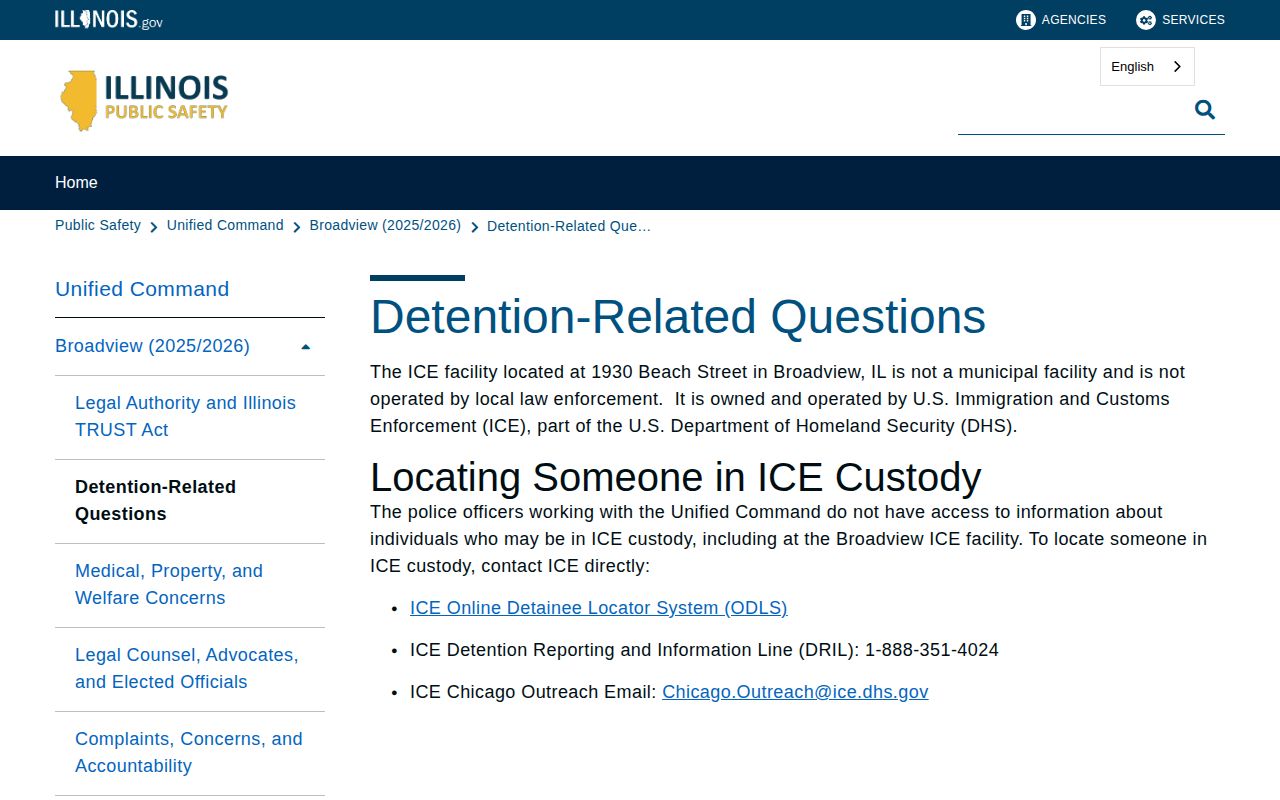
The official Illinois guidance is particularly useful because it directs families to ICE instead of implying that local government controls the facility. No capacity, detainee population, operating-hour, or release-feed statistic is supplied in the page-specific research. Those figures are therefore omitted. The reliable facility facts are the Beach Street location, ICE ownership and operation, and the ODLS, DRIL, and outreach paths.
County Discharge to ICE
A Cook County discharge and an ICE release are two distinct events. The Sheriff’s same-day Detainee Discharge Tracker answers whether the county booking cleared its workflow. It does not show a person’s immigration location, removal decision, or later federal release. Even the tracker word “Discharged” should be read as discharged from CCDOC, not necessarily discharged to the community.
For a durable handoff record, request the Sheriff’s booking and discharge material through its FOIA page or GovQA portal. Provide the full name, DOB, booking number, approximate admission date, and Cook County case number when known. Ask for the actual discharge date and time, disposition or reason, legal authority, and receiving agency or destination if the event was a transfer. Request segregable nonexempt portions with redactions.
If that record identifies ICE, move to ODLS and DRIL. If it names IDOC, use the state offender search instead. If it names a federal criminal custodian, use the BOP or USMS route. A person can pass through more than one system, so preserve the timestamps and identifiers from each record. The evidence chain should describe the county exit, federal assumption of custody, and eventual immigration outcome separately.
Release, Transfer, or Removal
An ODLS location or agency response showing continued custody answers the immediate location question but is not a future-release promise. A transfer can occur for processing, detention placement, transportation, or another federal purpose. Follow the updated location and retain the A-Number or other valid identifier. Do not use a stale Broadview association as if the person must still be at Beach Street.
A removal is not a local community release. Verification may involve ICE documentation, counsel, and immigration court records depending on the case. Avoid describing the person as “free” merely because ODLS no longer lists a domestic detention location. Conversely, release from ICE custody can leave immigration proceedings, reporting obligations, supervision, or conditions in place. Release from physical custody does not necessarily close the immigration matter.
A blank ODLS response is evidence only that the attempted search did not produce a visible match. It may reflect input error, update timing, scope limitations, or a changed custody outcome. Use DRIL and outreach to resolve it. Record the time of the search and the identifiers used, but do not publish them. A verified agency response or formal record is stronger than disappearance from a locator.
Keep Custody Systems Separate
The BOP Inmate Locator covers federal criminal custody and is the appropriate route for MCC Chicago or another BOP institution. It is not the Broadview ICE locator. BOP’s `Released` or `Not in BOP Custody` language means no longer in BOP custody, but BOP itself warns that another correctional or law-enforcement system may hold the person. ICE could be that receiving system. A BOP date therefore cannot prove the later immigration outcome.
IDOC covers Illinois prison and parole records, not ICE detention. Illinois VINE supports documented Illinois custody and court-event channels but is not promised here as a federal ICE history. The Cook County court docket explains the county case, yet a county dismissal, time-served ruling, or release order does not decide federal immigration detention. Use each record for the narrow event its custodian controls.
This system-by-system method also avoids a common timing error. The county record can close before the ICE tool updates; an ICE transfer can occur after a BOP release; and counsel may receive a case notice before a public locator changes. Preserve both events rather than forcing them into one release date.
Handle Immigration Data Carefully
Immigration records can expose country of birth, A-Numbers, family relationships, location, and legal status. Collect only what is needed to perform the official search, share it only with authorized people or the responsible agency, and avoid posting screenshots or search details publicly. Redact identifiers from notes sent beyond the person, counsel, or trusted family. A common-name match should never be amplified without DOB or another reliable identifier.
Describe outcomes factually and narrowly: “ICE confirmed continued custody,” “the agency identified a transfer,” “the available record supports removal,” or “ICE records support release under conditions.” Do not speculate about citizenship, legal claims, criminal history, or destination. An immigration hold or transfer is not itself a conviction, and a county case does not establish the result of federal immigration proceedings.
This information is for public-record navigation, personal knowledge, notification, and legal-process verification. It must not be used for employment, housing, credit, insurance, licensing, or another eligibility decision. When safety, representation, or an urgent deadline is involved, contact qualified immigration counsel and use ICE’s official channels rather than relying on copied database material.