
Request Cook County Supervision Records
When a formal copy is needed, ask for an existing order or agency action. State the case or offender number, date range, and exact record sought. Illinois FOIA generally provides five business days for an ordinary noncommercial response, with a permitted written extension in defined cases. Protected details may be redacted. Send a probation-order request to the Clerk, an IDOC profile or discharge request to IDOC, and a PRB action request to the Board.
Cook County Supervision Evidence
Verification works best when each agency is asked only about its own role. IDOC can show whether a state prisoner moved into parole or MSR and which parole district appears on the public profile. The Prisoner Review Board can document conditions, a revocation outcome, or a final-discharge action. The Cook County Clerk record can show that a judge imposed probation. Adult Probation holds the operational supervision record, subject to lawful access limits. No one source replaces all the others.
Begin with the last confirmed custody. If the person left Cook County Jail after dismissal, time served, or a probation sentence, an IDOC search may never contain the person. If the Sheriff or court shows commitment to IDOC, a later state profile can separate continued prison custody from release to supervision. Preserve the booking number, IDOC number, and case number because names alone can link the wrong records.
Illinois does not route every prison release through a discretionary hearing. Most modern determinate sentences move to MSR through sentence calculation. Older indeterminate cases and a separate youthful-review group can involve PRB release decisions. PRB still sets supervision conditions and handles revocation and final discharge. For routine Cook County parole verification, the IDOC status and date fields remain the starting point.
VINE may provide timely notice of a custody change, but it is not the final supervision record. Save the alert time and supplying agency. Then compare it with IDOC, PRB, or the Cook County court file. An absent public result, a warrant listing, or a roster disappearance cannot by itself prove that supervision began, ended, or was revoked.
Cook County Parole Versus Probation
Parole follows a state-prison term. In most modern Illinois determinate cases, the community term is technically mandatory supervised release, or MSR, though the public IDOC profile may use PAROLE. The Illinois Department of Corrections Parole Division performs day-to-day supervision. The Illinois Prisoner Review Board, or PRB, sets conditions, addresses revocation, and may approve early or final discharge. Neither agency imposes Cook County probation.
Probation is a community sentence entered by a judge. The Cook County Adult Probation Department overview identifies probation as court-ordered supervision and separates it from parole after prison. Certain people released before trial may instead report to Pretrial Services. That is not a criminal sentence. The case order and assigned-officer papers control.
| Status | Who orders it | Who supervises | Best public proof |
|---|---|---|---|
| Parole or MSR | Sentence law and PRB conditions | IDOC Parole Division | IDOC profile showing PAROLE, Parole Date, and district |
| Probation | Cook County judge | Cook County Adult Probation | Court disposition and supervision order |
| Pretrial supervision | Cook County judge | Cook County Pretrial Services | Release order and current court docket |
- Parole or MSR
- Supervision after physical release from an Illinois prison.
- Probation
- A judge-imposed community sentence, often without a state-prison release.
- Discharge
- Completion or formal termination of the sentence and supervision term.
- Revocation
- A final action that ends release status and can return a person to custody.
The evidence should always identify the person, the supervising authority, the status shown, and whether the cited date is release into supervision or final discharge.
Verify Cook County Parole Records
Start with the IDOC Individual in Custody Search only when a court or transfer record shows an Illinois prison commitment. Search by IDOC number when possible. Last name or birth date can also locate a profile, but common names require a careful match to birth date, county, case, sentence, and physical descriptors. Someone missing from the Cook County Jail roster but shown in an IDOC institution remains in state custody.
- Open the matching IDOC record and confirm the IDOC number and identity fields.
- Look for Offender Status: PAROLE, a Parole Date, and a parole-district location.
- Keep the Projected Discharge Date separate. It is the later expected end of sentence and supervision.
- Review PRB material if a violation, revocation, changed conditions, or final discharge is at issue.
- Use release paperwork and the assigned officer for reporting instructions. A district label is not a promise of a public walk-in file.
A completed sentence may no longer appear in the live IDOC search. IDOC FAQ 14 directs older completed records to the archived Record Search route. An empty live result therefore cannot prove that parole never occurred or that a record is wrong.
Check Cook County Probation Status
Research found no official public person-by-person Cook County probation or absconder database. The reliable chain begins with the criminal case. Search the Clerk of the Circuit Court record by case number where possible, then read the actual sentencing entry for probation, its term, and any later completion, violation, or modification. The Clerk warns that online case information is a brief, unofficial summary and can lag for days. A courthouse Public Access Terminal or certified copy is stronger when the timing matters.
The Adult Probation administration directory lists the George W. Dunne Cook County Administration Building, 69 W. Washington Street, Suite 1940, Chicago, Illinois, and 312-603-0258. A person under supervision should use the officer information supplied at sentencing. If that information was not received, courthouse contacts can route the inquiry. Office staff may limit what they disclose about another person.
Cook County Adult Probation
Administration: 69 W. Washington Street, Suite 1940, Chicago, IL
Directory: 312-603-0258
Record basis: sentencing order, docket, and assigned-officer paperwork
Cook County Revocation Records
A past parole date can remain correct even when a person later returns to custody. An alleged violation begins a different event. The PRB preliminary and final revocation process can result in release resuming, release resuming under changed conditions, no violation followed by an approved plan, or revocation with an IDOC recalculation. Current custody and the historical release milestone should both be recorded.
The PRB revocation results page publishes monthly final-outcome PDFs. The image below shows the official result channel rather than a county warrant list.
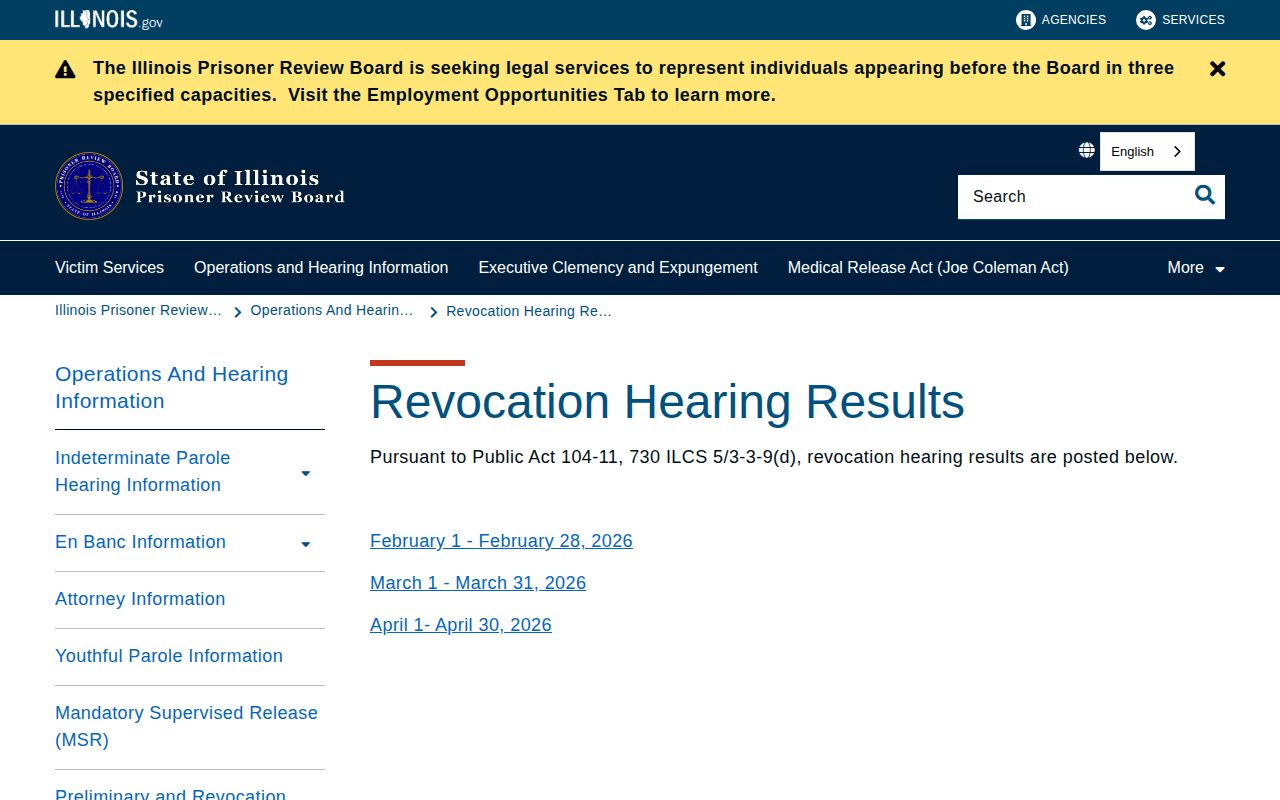
Match the posted outcome to the IDOC status before stating whether supervision resumed or was revoked. A warrant or arrest by itself does not establish the final supervision result.
Cook County Release Planning
The Cook County Jail has a local planning step that can sit between legal authorization and physical exit. The Records and RCDC Discharge Unit describes a Mental Health Liaison who interviews people being discharged, coordinates screening, and develops a discharge plan. When legal criteria are met, the process may include an inpatient petition.
This does not turn a county-jail discharge into parole. It helps explain why the Sheriff tracker can remain in a processing stage after a court has authorized release. For same-day proof, the booking-number tracker shows operational progress. The court order supplies the legal basis, and the durable Sheriff record can later state the actual discharge disposition.
Property After Cook County Release
Property handling gives a concrete clue about destination. The Sheriff’s property pickup instructions say that a person headed to IDOC or another facility signs and mails a release form so a recipient can collect property at Division 5. The recipient must bring identification, and pickup may take one to two hours. That route signals transfer, not return to the community.
A community discharge follows a different path. Keep property paperwork with the court and custody records because it may identify the transition even when a live roster has already changed. Still, property collection alone does not prove parole, probation, or final discharge.
Ending Cook County Supervision
Physical release and the end of legal supervision are separate milestones. IDOC’s Parole Date marks exit from physical state custody into parole or MSR. The later Projected Discharge Date anticipates completion of the sentence and supervision. It can move when credit, revocation, a corrected order, or another lawful calculation changes.
The PRB early and final discharge process considers compliance, risk and needs information, case factors, statements, and an IDOC recommendation. A final-discharge action is stronger proof that supervision ended than the original release date. For probation, look for a court completion or discharge entry. When an official record is needed, request the relevant order or agency record under Illinois FOIA, 5 ILCS 140, with full name, case or IDOC number, facility, and approximate dates.
Keep the agency name, identifier, status label, and observation date together. Those details let a later reader distinguish a supervision record from a custody transfer or court order.
Public Record Search
Sponsored Results