
Cook County Jail Release Paths
The Cook County Sheriff operates the Cook County Department of Corrections, or CCDOC, as one county pretrial jail system. A judge may authorize release, an older case may involve a bond discharge, or a person may complete the jail term. Those events start an internal review before the person physically leaves. Community return is only one possible outcome. A mittimus, which is a court order committing someone to prison, can send the person to the Illinois Department of Corrections. Another order can produce transport to a different jail, a hospital, or a federal agency.
That distinction controls the search. The Individual in Custody Locator describes current county custody. A missing name does not prove release. Use the Detainee Discharge Tracker when the booking number is known. If the destination is IDOC, continue with the state offender search. If the record identifies ICE, use the immigration locator. The Cook County released-inmate guide explains this custody-system triage in one place.
Confirm Cook County Jail Discharge
The Sheriff tracker is a same-day operations board, not a name-searchable archive. Enter the exact booking number. The result shows progress, discharge status, and whether processing reached “Discharged.” The board warns that processing can take five hours or more. A court order and a physical exit are separate milestones, so a delay does not by itself contradict the court docket.
The Sheriff-hosted discharge page shows the official workflow described above.
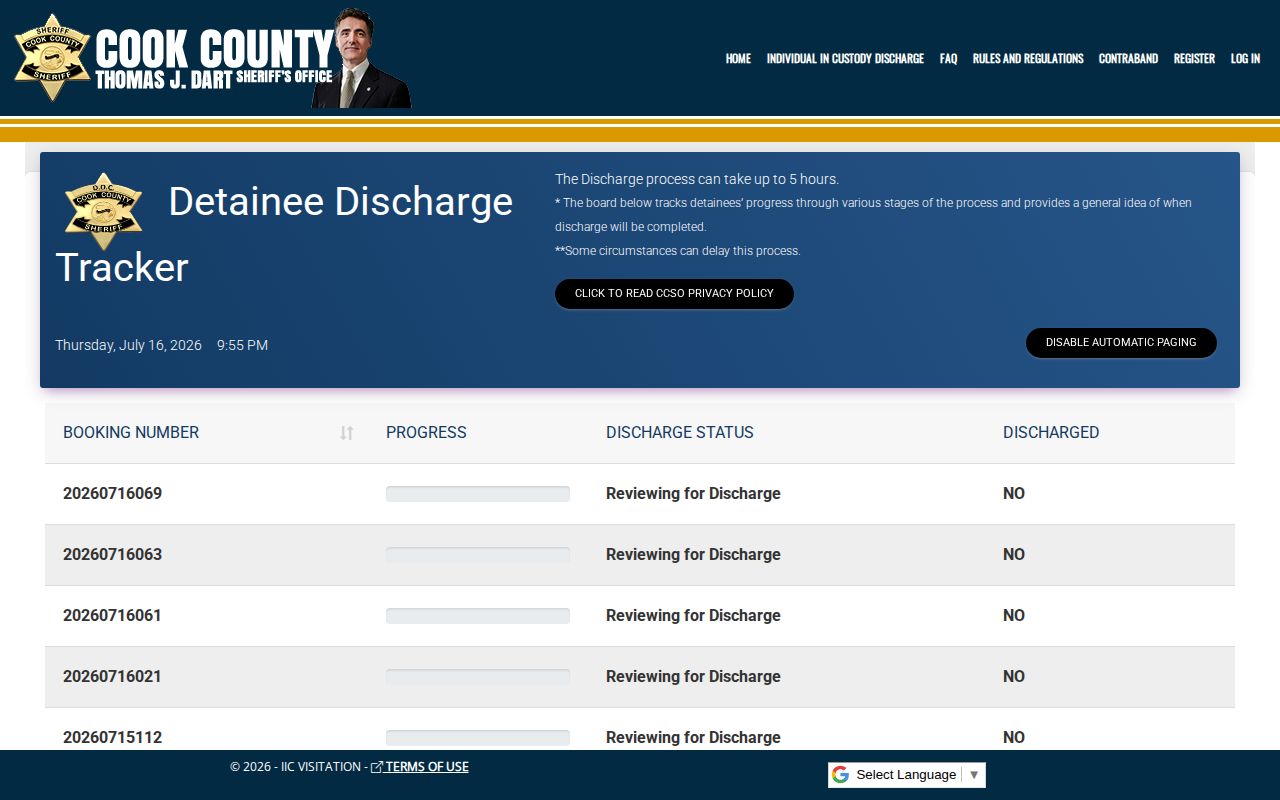
The screen’s booking-number focus is why a family member should preserve that identifier before a current locator result disappears. It does not supply the person’s name, charge, reason for release, final exit time, destination, or photograph. For those facts, obtain the Sheriff record and compare it with the official court disposition.
Cook County Release Record Requests
For an older event, submit a focused request through the Sheriff’s Freedom of Information Act page or GovQA portal. Give the full name, date of birth, booking number, approximate admission date, and case number when known. Ask for the booking and discharge record, actual discharge date and time, disposition or reason, legal authority, and receiving agency or destination if the event was a transfer. Request electronic, segregable nonexempt portions so protected material can be redacted without withholding the rest.
The FOIA Officer’s mailing address is Cook County Sheriff’s Office, Richard J. Daley Center, 50 W. Washington, Room 704, Chicago, IL 60602. The page identifies in-person delivery at Room 701. Illinois public bodies generally answer an ordinary noncommercial request within five business days and may give written notice of a permitted five-business-day extension. Keep the request number and response together with the court record.
Cook County Jail Contact Channels
Corrections Customer Service answers discharge, property, bonding, court-location, and trust-fund questions at 773-674-1945 and ccso.feedback@ccsheriff.org, daily from 8 a.m. to 8 p.m. Automated English and Spanish assistance is available at 773-674-5245; option 1 covers current custody and bond. The Sheriff FAQ lists Records at 773-674-6321. These lines can help route a present question, but the written release record remains the stronger proof of a past event.
The jail is a campus, not six separate release agencies. Housing locations include Division II at 2700 S. California Avenue, Division VI at 2801 S. Sacramento Avenue, Division IX at 2834 W. 31st Street, Division X at 2950 S. California Avenue, and Division XI at 3015 S. California Boulevard. Knowing the division helps with location and property, yet every building feeds the same CCDOC discharge system.
Cook County Transfer Property
Property handling offers a useful clue about destination. The Sheriff’s property instructions describe a special route before transport to IDOC or another correctional facility. The person signs and mails a release form so a recipient can take it with identification to Division 5. The Sheriff warns that pickup may take one to two hours.
That procedure helps explain why “left Cook County Jail” is too broad. A transfer can end county custody while continuing confinement elsewhere. Follow the receiving agency named on the discharge record rather than treating property release or disappearance from the roster as proof of community return.
Cook County Jail Campus History
The official jail-divisions inventory prevents old building lists from being mistaken for current release sites. Division II dates to 1955, first served as Chicago’s House of Corrections, and transferred to the Sheriff in 1970. It now houses minimum- and medium-classification men. Division III Annex houses women. Division IX includes medium- and maximum-classification housing, protective custody, and rehabilitation units. Division XVI includes Mental Health Transition Center participants.
The campus has changed. Division IV is closed, while Divisions I and III are listed as inactive. Division XVI reopened during the COVID period and now supports programming. External Operations handles perimeter security and transport. These facts matter because an old address or division label may describe where someone stayed, not a separate agency holding a release archive. Route all CCDOC discharge verification through the county-wide tools and records office.
After a Cook County Release
Read the destination before selecting the next record. A person returned to the community may have probation, which is court supervision instead of a prison sentence, or other court conditions. A person shown as transferred to IDOC remains confined until the state record later shows parole or mandatory supervised release. Parole means supervised release from state custody; final discharge comes later. A county notation involving ICE likewise does not establish community return.
For the legal outcome, use the Cook County Clerk’s online case information, then obtain an official or certified record if the short online summary is not enough. Court data can lag. The tracker can therefore show physical processing before the docket explains it. Positive records from the custodian, receiving agency, and court provide a much firmer chain than an empty roster result.
Cook County Release Evidence
A reliable verification file connects three forms of proof. Preserve the Sheriff’s operational result for the matching booking number. Request the lasting discharge record that states authority and destination. Then match the case number and identity against the Clerk’s disposition. Names alone are weak because common names and repeat bookings can point to the wrong event. Date of birth, booking number, admission date, and case number make the chain much more precise.
If the Sheriff record names another custodian, continue there. An IDOC profile may show an incarcerated location, later PAROLE status, a Parole Date, and a Projected Discharge Date. Those fields mark distinct stages. The parole date records physical release into state supervision, while projected discharge is the expected end of the whole sentence. A BOP result addresses federal custody. ICE confirmation addresses immigration custody. None substitutes for another.
Illinois VINE can give useful notice of a custody event, but it is not promised as a complete historical archive. Record the alert time, supplying agency, identifier, and event, then corroborate it with the agency record. The same care applies when a current roster returns no match. Absence is a lead to search elsewhere, never positive proof that the person walked out of custody.