
Leaving Crossroads ATC
Crossroads Adult Transition Center is a transitional-security facility for men within the Illinois state corrections system. The Safer Foundation operates it for IDOC. Adult transition centers support movement toward work and community reintegration, but placement at Crossroads is not parole, mandatory supervised release, or final discharge. IDOC’s adult transition center overview expressly explains that work-release participants remain in IDOC custody.
This status matters in Cook County because several systems overlap geographically. Crossroads is in Chicago, but the Cook County Sheriff does not operate it. The county’s Individual in Custody Locator and Detainee Discharge Tracker cover CCDOC bookings, not residents leaving an IDOC transition center. A person may have entered IDOC after a Cook County case, yet a move from prison to Crossroads remains an internal state-custody placement. Community movement from Crossroads likewise does not establish that the sentence has ended.
The positive physical-release record is ordinarily the later IDOC profile transition to PAROLE. Read that status with the Parole Date and the listed parole district. Illinois commonly calls the modern supervision period mandatory supervised release, or MSR, even though the public IDOC profile uses “PAROLE” vocabulary. Final discharge is later still: it means the sentence and supervision have ended, not merely that the individual left the Crossroads building.
Confirm a Crossroads Release
Begin at the official IDOC Individual in Custody Search. The linked application offers three routes: Last Name, IDOC Number, or Birthdate. An IDOC number is usually the strongest starting key. A full or partial surname can help locate a record, but never accept a name-only match. Compare the IDOC number, date of birth, physical descriptors, sentencing county, court case, marks or tattoos, photographs, admission information, and sentence rows.
- Search the IDOC system by IDOC number when available; otherwise use last name or birthdate.
- Open the matching profile and verify identity against the Cook County case or commitment record.
- Read Offender Status and Location. A Crossroads or other institutional location still means IDOC custody.
- For physical release, look for Offender Status: PAROLE, a parole-district location, and the actual Parole Date.
- Record the separately labeled Projected Discharge Date, but do not report it as the date the person left custody.
- If the completed sentence no longer appears, use IDOC’s archived Record Search process instead of treating the empty result as proof.
The live IDOC system may be unavailable during maintenance or data updates. General public custody information is available from IDOC at 217-558-2200. The Cook County release search guide also explains how to identify the responsible custody system before interpreting a result. That triage prevents a county jail, state ATC, federal facility, and immigration site from being treated as one release database.
Crossroads Records and Contact
The official Crossroads Adult Transition Center page lists the facility at 3210 W. Arthington, Chicago, IL 60624. The main telephone number is 773-533-5000, and the fax number is 773-533-0828. A call can clarify current facility routing, but a telephone statement is not a substitute for a dated IDOC profile or written archived record.
For a completed term that has dropped from the live search, use IDOC’s Contact Us form and choose the General Subject Record Search. Supply the full name, date of birth, approximate reception year, Crossroads or another known facility, Cook County as the sentencing county when applicable, and other known incarceration dates. IDOC FAQ 14 explains that the public website returns people currently incarcerated or on parole; once the sentence is complete, the information no longer displays in that live subset.
A formal IDOC records request can go to the FOIA Officer, 1301 Concordia Court, P.O. Box 19277, Springfield, IL 62794-9277; telephone 217-558-2200 ext. 4166; fax 217-558-5612; email DOC.FOIARequest@illinois.gov. Identify the person and the exact record sought, such as the custody history, Crossroads placement dates, parole date, discharge information, or sentence record. Protected information may be withheld or redacted. The goal is the releasable government record, not an inference from a missing search result.
Inside Crossroads ATC
IDOC describes Crossroads as a transitional-security facility for men and reports that it opened in August 1983. Its published figures require careful labeling. The agency gives an operational capacity of 374 and a population of 224 as of June 30, 2024. The narrative on the same official source separately refers to 330 beds. Those numbers should not be blended into a new estimate: operational capacity, dated population, and narrative bed count are distinct source statements.
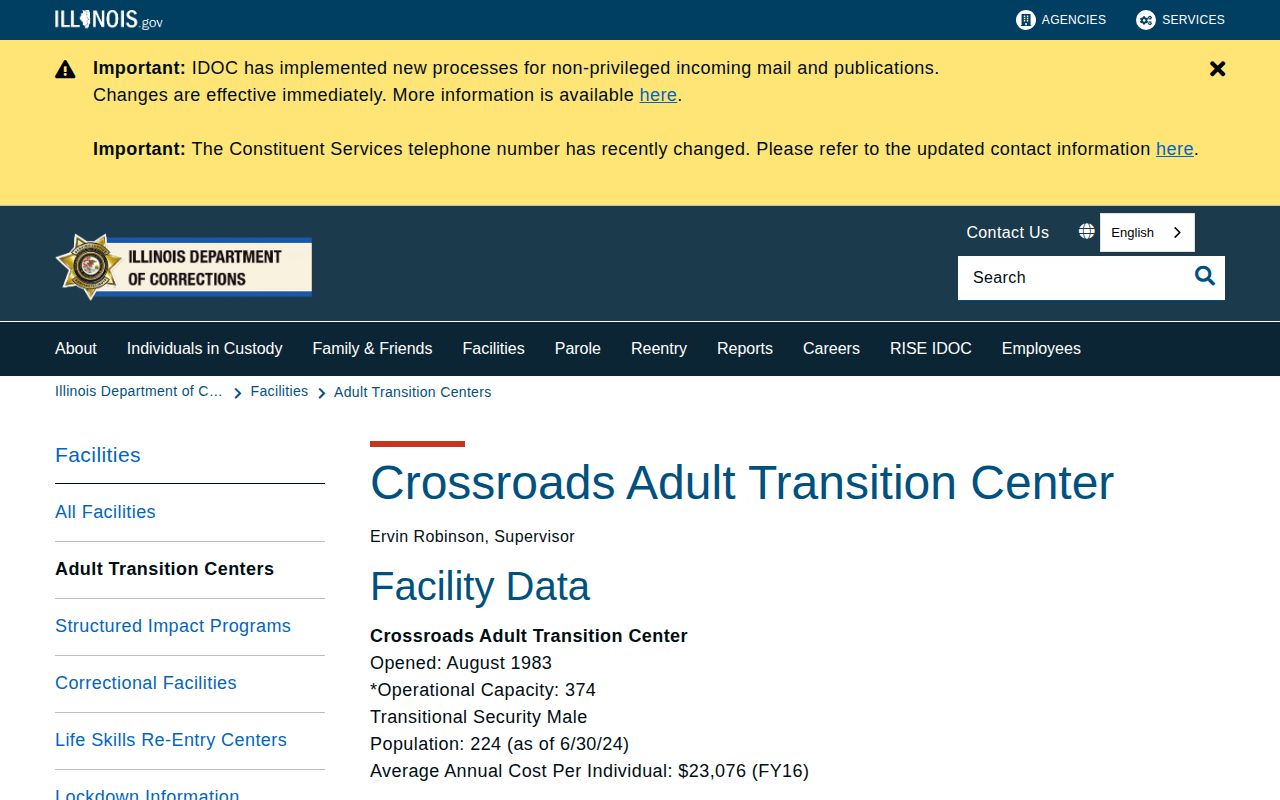
The center’s transitional purpose can make custody status look counterintuitive. Work, treatment, education, passes, or other approved community activity may resemble ordinary community living to an outside observer. Legally and administratively, however, the resident remains under IDOC custody until the later release action. Location at an ATC therefore belongs in the custody history; it is not itself a release date.
Parole Date Versus Discharge
IDOC’s date labels answer different questions. Projected Parole Date is the anticipated exit from physical custody into parole or MSR. On a profile already released to supervision, Parole Date or Last Paroled Date records an actual supervision milestone. Projected Discharge Date anticipates the later end of the sentence and supervision. Calling projected discharge the Crossroads exit day collapses two legally different events.
Projected dates can change. Illinois law uses different credit frameworks depending on the offense, offense date, statutory version, sentence structure, and court findings. Some covered sentences operate at 50%, 75%, 85%, or 100% frameworks. Credits can be earned, withheld, lost, or restored; consecutive counts, corrected commitment orders, custody-credit orders, appeals, detainers, and revocation may also alter the calculation. IDOC updates the profile when an award changes a projection, but it cannot promise whether discretionary credit will be awarded.
Use the date as IDOC labels it and record when it was observed. Do not independently calculate a personal release day from the sentence length or offense shorthand. A projected date is planning information, not proof of departure. The projected release date guide explains these fields and credit limits in greater depth.
When the Live Record Vanishes
A no-result screen has several possible meanings: the spelling or identifier may be wrong, the application may be updating, the person may never have entered IDOC, or the sentence may be fully complete and archived. IDOC’s own live-search boundary is decisive here. It shows people currently incarcerated or on parole; it is not a complete historical index of every former Illinois prisoner.
For an older Crossroads history, preserve identifiers from the sentencing case and request archived Record Search help. A useful request names the person, DOB, IDOC number if known, Cook County case number, approximate reception and Crossroads dates, and the specific milestone to verify. Ask whether the record supports placement, physical release to parole/MSR, or final sentence discharge. Those are three different claims.
If a conviction record needs correction, IDOC FAQ 7 says the agency acts on proper committing-court paperwork. Certified reversed or remanded verdict documentation and pardon or commutation material go with a cover letter to the IDOC Public Information Office at the Springfield address. An apparent discrepancy should be documented and corrected through that process, not overwritten based on a third-party listing.
Crossroads Figures Need Labels
The official Crossroads material demonstrates why publication dates and labels matter. The operational-capacity figure of 374, the population of 224 dated June 30, 2024, and the narrative’s 330-bed reference can all be reported without pretending they measure the same thing. Preserve each label and date. Never silently choose one number as “current capacity” or update the dated population through inference.
The same discipline applies to a person’s record. An ATC location establishes custody placement. A `PAROLE` status paired with a Parole Date establishes release into supervision. A Projected Discharge Date is an anticipated later milestone. Only an archive or final-discharge record supports the stronger claim that the entire sentence ended. This minimum-evidence rule protects against turning community movement, a blank screen, or a future date into an unsupported release claim.