
Cook County Juvenile Release Paths
The Cook County Juvenile Temporary Detention Center, often called the JTDC, provides temporary secure housing for court-involved youth. It is under the Office of the Chief Judge of the Circuit Court of Cook County. The center is not an adult county jail, and its residents do not pass through the Cook County Sheriff’s public discharge tracker. Their movement depends on a juvenile-court order and the circumstances of the case. That legal structure changes both what “release” means and who may receive information.
A youth may leave the Cook County Juvenile Temporary Detention Center to return to a parent or guardian. The court may instead approve a community placement with specific terms. Another outcome is transfer to the Illinois Department of Juvenile Justice, known as IDJJ. In a case moved to Criminal Court jurisdiction, an order may direct transfer to the Cook County Jail, the Illinois Department of Corrections, or another lawful custodian. A transfer ends the JTDC stay but does not mean the youth returned to the community. The court order and receiving agency are the key proof.
JTDC Release Search Limits
No public name-search workflow should be built around Cook County juvenile detention. Juvenile confidentiality means the adult Sheriff locator, adult discharge tracker, and ordinary adult release-record assumptions do not apply. A blank result in an adult tool says nothing reliable about a young person’s custody status. It may simply show that the wrong system was searched. Public-facing adult tools are designed for other populations and other agencies.
Can the adult discharge tracker confirm a JTDC release? No. The Sheriff tracker follows adult Cook County Department of Corrections discharge processing by booking number. The Cook County Juvenile Temporary Detention Center is governed through the juvenile court. Authorized parties should use their Juvenile Division, counsel, and facility contacts instead.
The safest question is not “Where can I search the youth’s name?” Ask which authorized channel holds the order and may discuss it with the requester. Counsel can read and explain the court order. A parent or guardian with authority can use the contact path supplied by the facility or court. A court participant can work through the assigned Juvenile Division channel. These routes protect the youth while still letting an authorized person confirm whether the order calls for family return, placement, or transfer.
Confirm a Cook County Release
Start with the paperwork or direct notice already provided in the case. Identify the Cook County case, the assigned court channel, the date of the expected action, and the last confirmed custodian. Then ask the authorized contact to confirm three distinct facts: what the judge ordered, whether the Cook County Juvenile Temporary Detention Center completed the movement, and where the youth went. A release order can authorize an outcome before the physical handoff is finished. For that reason, the order and the completed facility movement are separate milestones.
If the youth returned to a parent or guardian, the authorized release instructions and the court order form the core record. If the court chose a community placement, the order should be read for the approved destination and conditions. If the youth went to IDJJ, IDOC, the adult Cook County Jail, or another agency, obtain the receiving custodian’s name through the authorized case channel. Do not describe that transfer as release to the community. Continue verification with the agency that received custody, using only the access allowed for that case.
The Cook County release-record overview explains why a person leaving one facility can remain in another custody system. That general distinction matters at the JTDC, but juvenile confidentiality still controls. The public adult methods described for county, state, federal, or immigration custody must not be used to bypass protections in a juvenile matter.
Cook County Authorized Channels
The right channel depends on the requester’s role. A parent or guardian should use contact instructions already issued by the Cook County Juvenile Temporary Detention Center or Juvenile Division. Counsel should work through the court file, the assigned courtroom process, and direct facility contacts available in the representation. Other authorized court participants should use the route supplied for that case. A person without authorization should not expect staff to confirm whether a named youth is present, has left, or went to a specific placement.
The official Cook County JTDC page identifies the facility and its role.
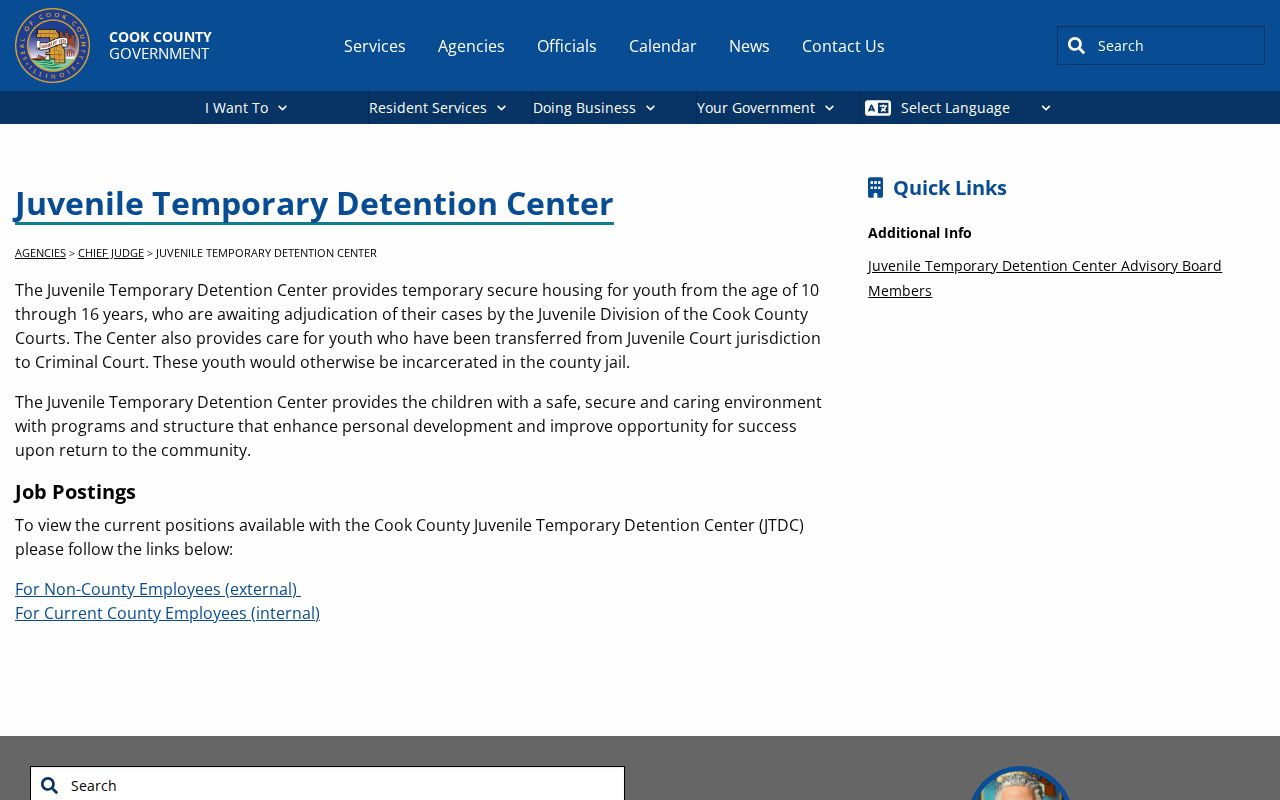
The county source describes secure temporary housing tied to juvenile proceedings. It is the proper public starting point for facility identity, not a released-youth roster. Case-specific status still belongs with the court, counsel, facility, and authorized family channels.
When contacting an authorized office, keep the request narrow. Give the case or reference information the office has directed you to use, state your relationship to the youth, and ask what proof of authority or identity is required. Do not send sensitive facts to an unrelated public inbox. A narrow request helps the office authenticate the requester and answer within the limits imposed on juvenile information.
JTDC Court Transfer Distinctions
A move from the Cook County Juvenile Temporary Detention Center to IDJJ continues youth custody under the state juvenile corrections system. A transfer to IDOC is a state adult-corrections outcome. Transfer to the Cook County Jail places the person in the adult county custody system when legally ordered. Each receiving system has its own record and rules. None of these movements proves community return merely because the JTDC stay ended.
Some youth at the Cook County center have been transferred to Criminal Court jurisdiction. Jurisdiction describes which court is handling the case. It does not by itself prove where the person is held or that a release occurred. Read the actual custody or placement order. If adult county custody is the named destination, the Cook County Jail release page describes that separate system. The adult Sheriff tracker becomes relevant only after an adult CCDOC booking exists. It cannot retroactively serve as a juvenile release archive.
Destination is therefore as important as departure. An authorized confirmation should identify whether the youth went to a parent or guardian, a court-approved placement, IDJJ, IDOC, the adult county jail, or another stated custodian. If the record does not make the destination clear, ask counsel or the Juvenile Division to explain the order. Do not infer the answer from a public locator.
Cook County Juvenile Records
Juvenile information is not treated like an ordinary public adult booking record. A general public-record request is not a substitute for authorized access to a youth’s case. Identifying details, custody information, court records, photographs, medical facts, security information, and third-party information may be confidential or otherwise restricted. The lack of a public response does not prove that no record exists. It may mean the record cannot be released to that requester.
Authorized parties should ask for the specific document needed for the case or legal process. Useful categories may include the controlling court order, authorized release instructions, a placement or transfer directive, and confirmation of the receiving agency. The correct custodian depends on who created the document. The court holds its orders. The facility holds its own operational records. A receiving agency holds the later custody record. Counsel can help identify which record answers the question without seeking unrelated protected material.
What proves that a youth left the JTDC? The strongest chain joins the court’s legal direction to authorized confirmation that the facility carried it out. If another agency received the youth, add that agency’s authorized acknowledgment. A name missing from an adult roster is not part of that proof.
JTDC Facility Contact
The Cook County Juvenile Temporary Detention Center is at 1100 S. Hamilton Avenue, Chicago, Illinois. It serves youth ages 10 through 16 who are awaiting Juvenile Division adjudication, along with some youth transferred to Criminal Court jurisdiction. “Adjudication” is the juvenile-court process for deciding the case. The center provides temporary secure housing while that process and related court orders are pending.
Use the official facility page for current public contact routing. Case-specific communication should follow the channel given to the parent, guardian, counsel, or court participant. Staff may need to verify identity and authority before discussing any youth. That check is a safeguard, not proof of continued detention. Public callers should not press staff to disclose a youth’s status when they lack a recognized role in the case.
After a Cook County Release
After family return or community placement, the juvenile court order remains the main source for what comes next. It may contain terms that authorized parties need to follow. Questions about those terms should go to counsel or the assigned court channel. A facility departure does not erase the case, end all court authority, or turn confidential juvenile material into an adult public release record.
After a transfer, continue with the named receiving agency. IDJJ, IDOC, and the Cook County Jail are distinct custodians. The Cook County Juvenile Temporary Detention Center cannot supply a full later history for another system. Record the handoff accurately, preserve the court direction, and avoid sharing sensitive details beyond those who need them for notification, family coordination, or the legal process.
This careful route prevents two common errors. The first is treating any departure as community release. The second is using adult search tools to draw conclusions about a juvenile case. For Cook County JTDC matters, authorized confirmation and the exact court-directed destination are the sound basis for understanding what occurred.